

Facilities, Equipment, and Other Resources
Vicon Motion Capture System
Located in Baylor Research and Innovation Collaborative (BRIC), the Advanced Vehicle Intelligence and Autonomy (AVIA) Laboratory, directed by Dr. Liang Sun, is housed in a 25’x60’ (1500 square foot) motion capture studio complete with 14 Vicon Vantage motion capture cameras, 3 AMTI BP400600 force plates, Biodex muscle strength dynamometer, Noraxon wireless 16 channel EMG, patient changing room, computer command station, and storage closet. The lab has a 4.5” raised floor to allow the force plates to be flush with the walking surface and to allow all cords to be run out of sight. Metal trusses span the length of the floor at a height of 8’ to allow for the easy placement of the motion capture cameras. The ceiling is 20’ off the ground, allowing for easy measurement of people walking up and down the removable 4-step stair system. This facility was completed in August of 2015 and is fully functional. The motion capture system is a Vicon Vantage system with Nexus 2 software. The lab is being renovated to accommodate rigid objects such as aerial vehicles, and the latest Tracker software is being purchased. The system specs are as follows:
- Vicon Vantage 5 cameras (quantity 10) – 420 frames/second, 5 Megapixel resolution
- Vicon Vantage 8 cameras (quantity 4) – 260 frames/second, 8 Megapixel resolution
- 2 desktop collection computers, 2 (or more) high-performance laptops.
Drone Soccer
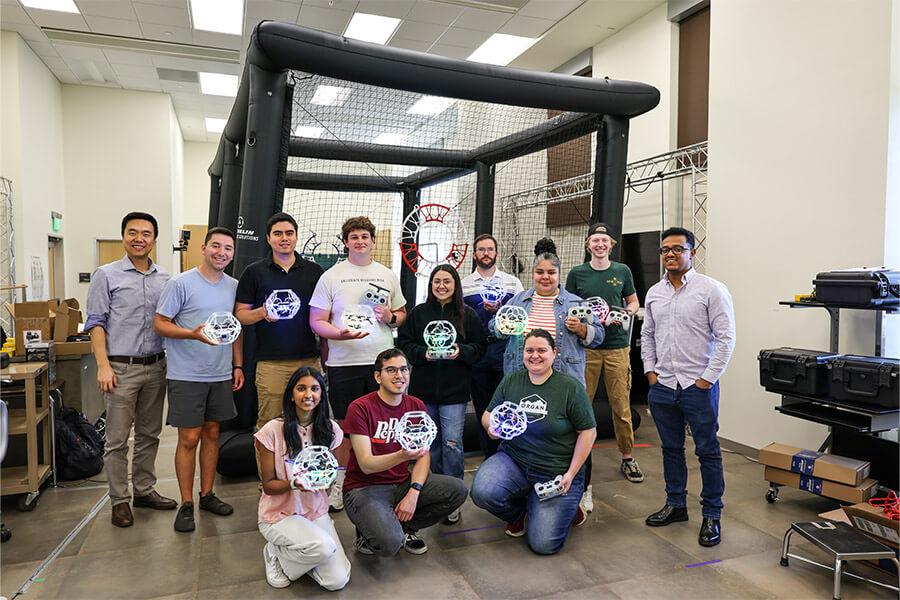
AVIA lab also houses a drone soccer platform. U.S. Drone Soccer is an internationally recognized, FAA-accredited educational robotics competition that combines aerospace engineering, team-based gameplay, and career pathway development. Students design, build, program, and repair professional-grade quadcopters enclosed in protective cages for full-contact matches, competing to score points while defending against opponents.
The program serves as an early workforce development pipeline, extending aviation and technical skills training to students as young as 12 and progressing toward university-level pilot training, air traffic control, A&P technician certification, and engineering careers. All teams are co-ed by design, directly addressing gender bias and broadening participation among women and historically underrepresented groups in STEM.
Drone soccer is an educational team sport played by teams of 3 to 5 players, with each player controlling a 20cm drone. The arena is approximately 10x20x10 ft. and is equipped with two goal rings where each team's striker can score. Drone soccer is a great (and fun) way to bring students close to drones and STEM research.
GPS-denied Development Drone
AVIA lab houses a ModalAI Starling 2 Max GPS-denied Development Drone. The Starling 2 Max is VOXL 2-powered, NDAA-compliant development drone supercharged by VOXL SDK specifically designed for computer vision-based, long-range dead reckoning with a 500g payload capacity. Powered by Blue UAS Framework autopilot, VOXL 2, the Starling 2 Max weighs 500g and boasts an impressive 55 minutes of autonomous flight time.
The VOXL 2 features are as follows:
- VOXL 2 is powered by Qualcomm QRB5165: 8 cores up to 3.091GHz, 8GB LPDDR5
- Abundance of perception capabilities built into Starling 2 Max with dual Sony IMX412 and dual OnSemi AR0144 image sensors
- Integrated flight controller on DSP with TDK ICM-42688 IMU and ICP-10111 Barometer
- VOXL ESC Mini 4-in-1
Software Features:
- Advanced Autonomy
- Visual Inertial Odometry to navigate in GPS-denied environments
- TFLite Neural Networks run object classification, detection, and other models
- Open-source software: OpenCV, ROS 2, Docker, PX4 integrated flight controller
VOXL SDK
Trinity Pro VTOL UAV
The Trinity Pro is a professional fixed-wing VTOL (Vertical Takeoff and Landing) unmanned aerial system designed for high-end surveying, mapping, inspection, and research missions. By combining the efficiency of fixed-wing flight with the flexibility of vertical takeoff and landing, it enables long-endurance operations without requiring a runway.
Key Capabilities
- Vertical takeoff and landing in confined environments
- Long-endurance autonomous flight
- High-accuracy waypoint navigation
- Integration with RGB, multispectral, and LiDAR payloads
- High-resolution aerial mapping and photogrammetry
Real-time mission monitoring and automated flight planning
Research Applications
- Autonomous mission planning
- Environmental monitoring
- Precision agriculture
- Infrastructure inspection
- Large-area mapping
- Energy-efficient flight planning
Navigation under varying wind conditions
Crazyflie Nano Quadcopter
The Crazyflie is an ultra-lightweight open-source nano quadcopter widely used in robotics and autonomous systems research. Its compact size and programmable architecture make it an ideal platform for rapid experimentation, algorithm development, and indoor flight testing.
Key Capabilities
- Fully programmable open-source platform
- Indoor autonomous flight
- Precise motion capture integration
- Swarm coordination and multi-agent experimentation
- Real-time onboard control and sensing
- ROS and Python support
Modular expansion with cameras, ranging sensors, and AI decks
Research Applications
- Autonomous navigation
- Swarm robotics
- Multi-agent coordination
- Reinforcement learning
- Control systems development
- State estimation and localization
- Human-robot interaction
- Indoor autonomous flight validation
Other Equipment
- VR headset
- Real Flight Simulator
- Computers/Laptops