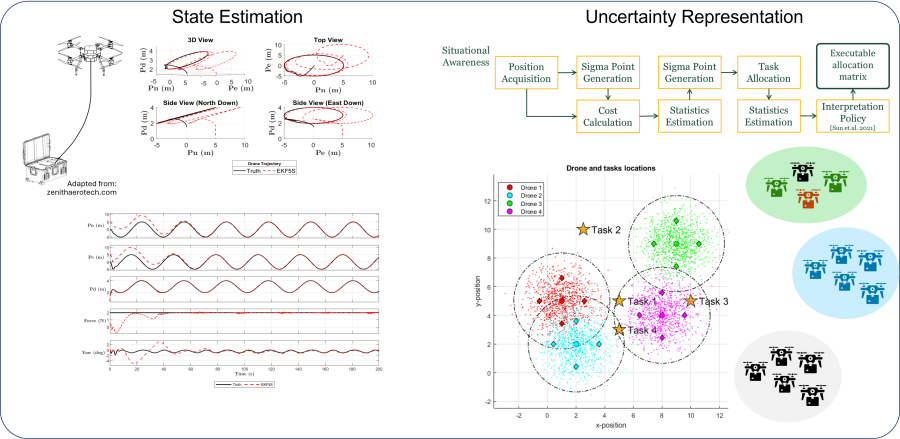
State Estimation and Uncertainty Representation
Accurate state estimation and uncertainty representation are critical in enabling robust task allocation for autonomous tethered drone systems, particularly in environments with unreliable GPS signals and uncertainties. This research area leverages the Kalman Filter (KF) to estimate the drone’s three-dimensional position, heading angle, and cable tension using only onboard sensor data. The KF effectively compensates for noisy measurements, providing reliable localization and orientation even under adverse conditions.
In the broader context of task allocation, uncertainty representation becomes essential when drones must operate under incomplete or imprecise information. Factors such as communication delays, signal losses, and fluctuating sensor accuracy introduce ambiguity in both the drone’s current state and the external task environment. Representing and accounting for these uncertainties, such as modeling estimation errors or probabilistic task assignments, enables the drone system to make more informed and adaptive decisions. This improves the coordination and reliability of task allocation, especially in multi-drone settings where dynamic changes in position or task status must be resolved under uncertain conditions.