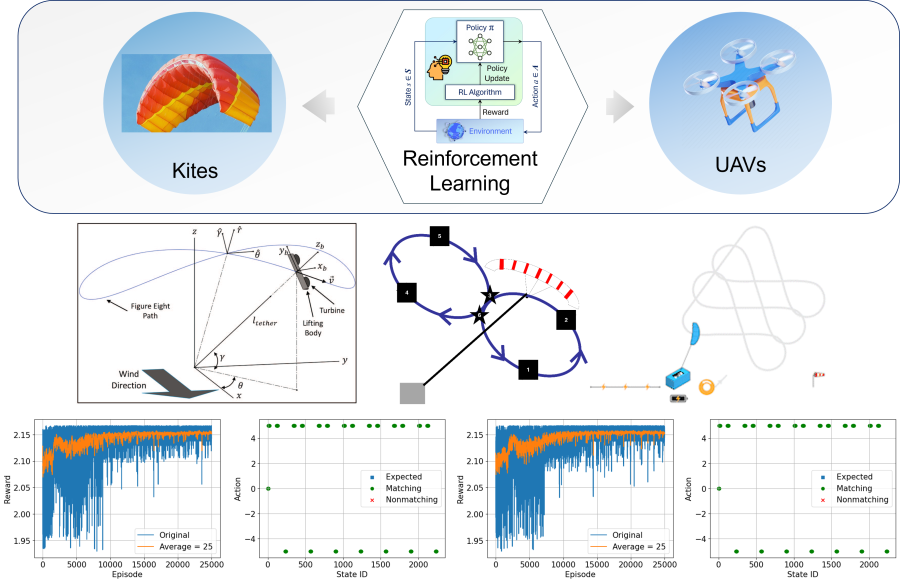
Tethered & Airborne Wind Energy Systems
Reinforcement Learning (RL) has emerged as a powerful approach for optimizing complex control tasks in dynamic environments. It is highly suitable for kite energy harvesting and UAV/drone path planning and control.
Kite Energy Harvesting
In airborne wind energy (AWE) systems, kites or tethered drones extract wind energy by following optimal flight trajectories. RL enables autonomous control policies that adapt to changing wind conditions, maximizing power generation while maintaining stability. By learning from environmental feedback, RL algorithms optimize reel-in and reel-out phases, regulate tether tension, and maintain energy-efficient crosswind flight patterns, outperforming traditional control techniques.
UAV/Drone Path Planning and Control
RL facilitates intelligent navigation and decision-making for UAVs and drones in dynamic and uncertain environments. RL-based controllers optimize path planning by balancing multiple objectives, such as energy efficiency, obstacle avoidance, and mission constraints. RL allows UAVs to learn socially aware and cooperative behaviors in urban air mobility, delivery networks, or search-and-rescue operations, improving operational safety and efficiency. Moreover, in multi-agent scenarios, RL enhances swarm coordination, enabling UAV teams to adapt to environmental changes dynamically.