Overview
Mobility-Energy-Coordinated Platform for Infrastructure Planning (MECPIP) to Support AAM Operations
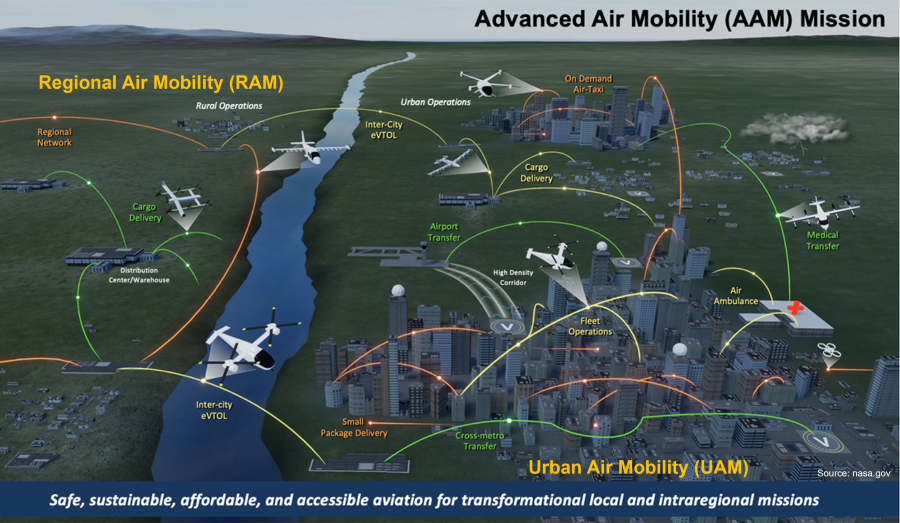
The electrification of Advanced Air Mobility (AAM), including Urban Air Mobility (UAM) and Regional Air
Mobility (RAM), aims to eliminate tailpipe emissions but will lead to a significant increase in electric
demand, which requires the readiness of electric infrastructure. The overarching goal of this ULI project is to
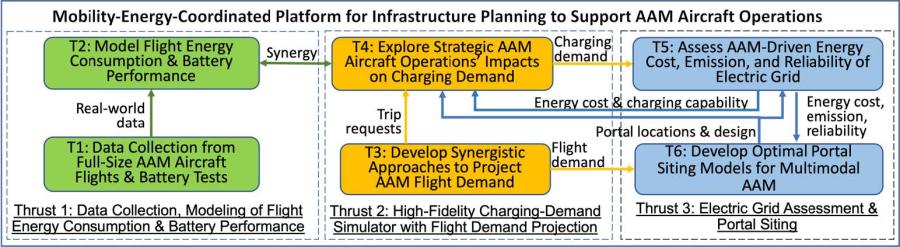
develop a mobility-energy-coordinated platform for efficient infrastructure planning. To achieve this goal, the
project will (1) collect data from real-world flight tests and battery tests for model validation and calibration,
(2) project electric charging demand by modeling flight energy consumption, battery dynamics, and trip
requests, (3) assess energy cost, emission, and reliability from an electric grid perspective, and (4) develop a
holistic optimization model for AAM portal siting by considering electric-grid readiness assessment. The three
research thrusts and six tasks are illustrated in the figure below.
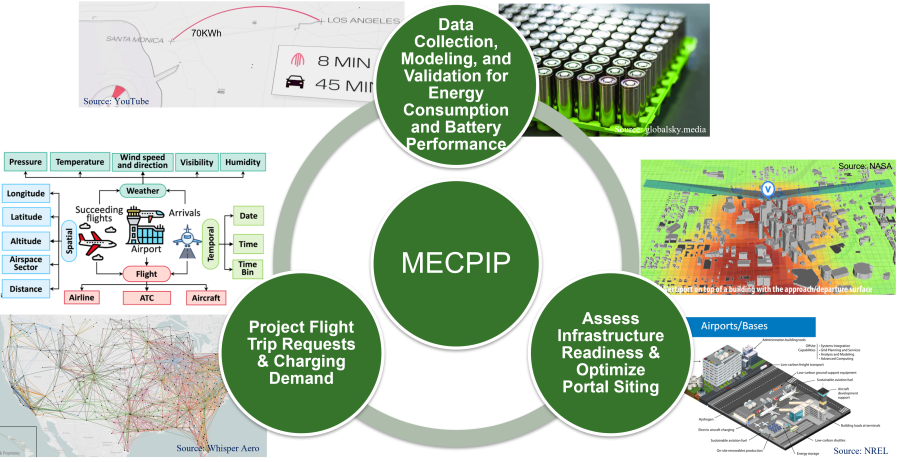
The MECPIP project will support AAM implementation by conducting the following fundamental research:
(1) integrate environmental disturbances (e.g., wind) into physics-based flight energy-consumption models to
enhance the accuracy of energy consumption calculation; (2) develop the state-of-the-art battery dynamics
models to calibrate the physics-based flight energy consumption models based on real-world full-size AAM
aircraft flight and battery data; (3) develop computationally scalable optimization-based methods to project
charging demand for large-scale centralized and distributed AAM operations; and (4) develop multi-objective
AAM portal siting optimization models to achieve Pareto optimum to trade off cost, environmental
sustainability, safety, and efficiency.
AAM: Urban & Regional Air Mobility